Pacific College
 

Business Administration
Bachelor of Science

The Bachelor of Business Administration program provides instruction and application of skills and knowledge that represent the ways in which businesses operate in a competitive and global business environment. Graduates will be equipped with skills that can suit many different positions, industries, and organizations. Coursework is designed to integrate information and theories from management and leadership, accounting, economics, finance, marketing, business law, human resources, ethics, and information systems to develop broadly educated graduates who fully understand how businesses operate and can apply tools and techniques to a wide variety of domestic and international business situations.

Upon successful completion of this program, graduates will be able to:

  1. Employ critical thinking skills to evaluate the practical implications of organizational policies, decisions and strategies

  2. Organize ideas and communicate effectively

  3. Identify, research, analyze and solve complex business problems using appropriate technological and analytical tools

  4. Identify and communicate the variety of risks and opportunities of doing business in a global environment

CAREER OUTLOOK
BUSINESS ADMINISTRATION (SOC CODE: 11-3012.00)

Candidates with a BS-BA degree may be eligible for supervisory and managerial positions in a variety of organizations. They may work in occupations where they will establish plans and policies, direct business activities, and oversee people, products, and services that would help an organization to run efficiently.

This degree prepares students for a broad spectrum of business positions and opportunities.

WHAT TYPE OF WORK DO BUSINESS ADMINISTRATORS DO?

Business Administrators are employed in supervisory and management positions within organizations. They employ critical thinking skills to evaluate practical implications of organizational policies, decisions, and strategies. They organize ideas and communicate effectively. In addition, they may prepare operational budgets, hire personnel, direct administrative or support services.

Business Administrators identify, research, analyze, and solve complex business problems using appropriate technological and analytical tools, and identify and communicate the variety of risks and opportunities of doing business in a global environment.

CALIFORNIA EMPLOYMENT TRENDS FOR BUSINESS ADMINISTRATORS

California employment of Business Administrators was 48,100 employees in 2020. The need is projected to grow 16 percent from 2020 to 2030. It’s projected there will be 4,860 openings each year from 2020 until 2030.

Source: O*Net California Employment Trends for Business Administrators (Service Managers)

MEDIAN PAY FOR BUSINESS ADMINISTRATORS

Region Median Hourly Median Annually
California $50.79 $105,650
Los Angeles and Orange Counties $51.56 $107,250
Riverside and San Bernardino Counties $48.63 $101,140
San Diego County $45.10 $93,310
San Francisco and Oakland Area $56.32 $117,140

ADMISSION Requirements
Bachelor of Science in business Administration

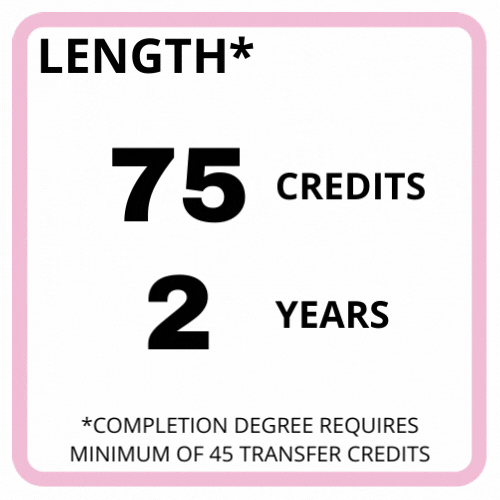
Up to 60 units of transfer credit from an accredited post-secondary education institution may be brought in.

Applicants transferring from an accredited college or university are admitted as degree students if their cumulative grade point average from all schools is 2.0 (C) or better.

Applicants with a cumulative grade point average below 2.0 may be admitted on a probationary status if the College determines there is sufficient evidence of potential to complete college studies.

PROGRAM COURSEWORK
BACHELOR OF SCIENCE IN BUSINESS ADMINISTRATION

Principles of Business
BUS 301 - 3 credits

Principles and functions of business and the objectives and operations of corporate and small business managerial decision-making process. The relationship between businesses and consumers, internal and external stakeholders and how those relationships impact business operations are discussed. Course topics include the impact of globalization on business operations, and how economic, political, legal, and social issues impact business operations.

Financial Accounting
ACC 301 - 3 credits

This course covers development and application of financial accounting concepts and generally accepted accounting principles. Student will be able to prepare financial statements, accounting for changes in accounting principles.

Operations and Supply Chain Management
BUS 325 - 3 credits

The planning, coordination, and control of all activities involved in producing and delivering products and services. Students will develop essential skills for managing operational systems effectively.

Strategic Communication for Business
BUS 312 - 3 credits

An introduction to the general field of strategic communication from a business perspective, with an emphasis on audience analysis, integrated marketing communications, message design, advertising, ethical considerations, and development of presentation and writing skills.

Business Law and Ethical Decision Making
BUS 420 - 3 credits

Foundational information about the U.S. legal system and dispute resolution, and their impact on business. The major content areas will include general principles of law, the relationship of business and the U.S. Constitution, state and federal legal systems, the relationship between law and ethics and ethical decision-making, contracts, sales, torts, agency law, intellectual property, and business law in the global context.

Global Business and Cultural Intelligence
BUS 350 - 3 credits

The course examines global economies and markets, such as business customs, multinational businesses and foreign trade practices. Students also study foreign business environments, cultural dynamics, economic developments and political impacts on foreign businesses.


Entrepreneurship
BUS 435 - 3 credits

Theory and practical application of the small business principles necessary for the operation of a successful small business. This course is designed for students who want to evaluate going into business for themselves or working for a small business. Topics include creating and updating a small business plan, small business sales, cash flow, expenditure, and the concepts of current practices of managing a small business.

Business Analytics and Data-Drive Decisions
BUS 430 - 3 credits

Introduction to fundamental concepts and applications in core business disciplines such as financial accounting, marketing, operations, and strategy and how data and analytics can be used in these domains to drive value and innovation. Real-world business analytics applications from different domains are studied.

Business Capstone Project
BUS 499 - 3 credits

Students will create a small business from ideation to creation, creating a functional business plan and docket along the way. All work will be done with real world data and scenarios.

Leadership and Human Relations
BUS 465 - 3 credits

This course provides students with experience in decision-making, conflict resolution and management. Students will focus on effective business strategies, diversity, the power of influence, leadership opportunities and ethics.

Global Economic Systems
ECN 320 - 3 credits

An overview of the world economy and why it operates as it does. Discussion of the discourse and politics of “globalization,” and the critical processes that shaped the contemporary global economy, including the emergence of transnational corporations and the dynamics that shape economies.

Excel for Business Applications
CIS 301 - 3 credits

Excel techniques and methods in the context of business. Topics examined and developed include macros and business model/application development. Design and use of “what-if” analysis, static and dynamic web pages, financial functions, data and lookup tables, amortization schedules and templates. Includes working with multiple worksheets and workbooks, analyzing worksheet results, sorting and querying a worksheet database, using macros, and integrating software.

Principles of Management
MGT 320 - 3 credits

This course presents the principles, techniques, and concepts needed for managerial analysis and decision-making. It highlights the effective management of planning, organizing, influencing, and controlling related to the internal and external environment and issues of ethics and social responsibility.

Communication for the Workplace
GE 330 - 3 credits

Development of an understanding of what is needed and meant by workplace literacy and what can be done to improve the basic skills and literacy for working employees. Course content includes principles of effective writing and oral communication for education and the workplace, extensive practice in various forms of writing for the workplace, the methodology of teaching communication skills to employees, and case studies of workplace reports, negotiations, and oral presentations.

Marketing Principles and Strategies
MKT 300 - 3 credits

A comprehensive introduction to marketing concepts, strategies, and practices, focusing on creating value and understanding consumer behavior. Examination of the structure and analysis of consumer and industrial markets and the behavior of business firms in the competitive economy. Marketing policies and practices, marketing consumer goods, and marketing industrial goods are included.

Organizational Behavior
MGT 340 - 3 credits

Studies the impact that individuals, groups and organizational structures and processes have on behavior within organizations. Examines the foundations of individual and small-group behavior and how this behavior affects organizational processes and performance.


E-Commerce and Social Media Strategies
MKT 400 - 3 credits

Developing digital marketing and e-commerce strategies to attract and engage customers through digital marketing, how to integrate effective SEO strategies into social media activities to enhance visibility on major search engines like Google, YouTube, Yahoo, and Bing.

Consumer Behavior
MKT 310 - 3 credits

A comprehensive study of behavioral models and concepts designed to help understand, evaluate, and predict consumer behavior. Deepens a student’s knowledge about consumer psychology and applies the knowledge from the perspective of a marketing manager. Stresses analytical thinking about consumer psychology and prediction of how marketing tactics may influence demand for products and services.